
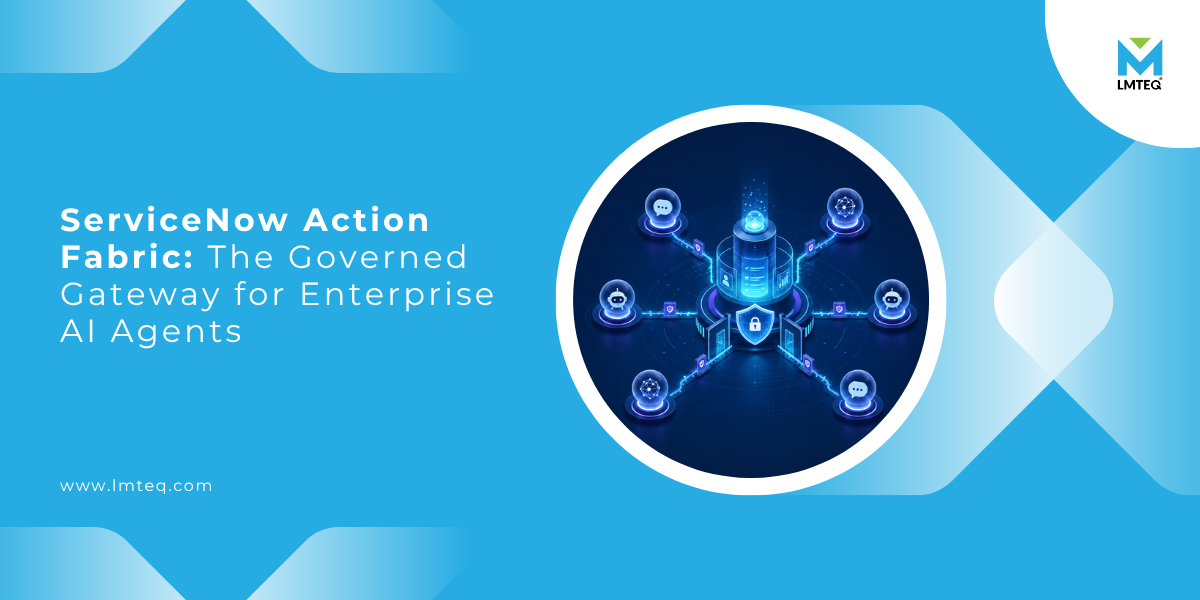
Enterprise AI has a new problem to solve. Employees are already working inside AI assistants like Claude and Microsoft Copilot every single day. But until now, if that AI assistant needed to do something inside ServiceNow, like raising a ticket or approving a request, someone still had to open the ServiceNow portal and click through it manually.
ServiceNow Action Fabric, announced at Knowledge 2026, changes that. It lets external AI agents trigger real, governed actions inside ServiceNow directly, without opening the portal at all.
1. What Is ServiceNow Action Fabric
Action Fabric is a new capability that opens ServiceNow’s full system of action to any AI agent, not just ServiceNow’s own AI tools. In practical terms, this means an AI agent built on Claude, Copilot, or a company’s own AI stack can now execute workflows, approvals, and catalog actions natively inside ServiceNow.
ServiceNow has been clear about what this is not. It is not a way to simply access ServiceNow data. It is governed execution, meaning flows, playbooks, approvals, and catalog actions run through the same control layer as any native ServiceNow action.
2. How Action Fabric Works: The Role of MCP
Action Fabric is delivered through a generally available Model Context Protocol (MCP) Server. MCP acts as a common connection standard between AI agents and enterprise systems. Instead of building custom integration code for every AI tool a company might use, ServiceNow built one MCP Server that any MCP compatible AI agent can connect to.
Once connected, the AI agent does not need to log into ServiceNow or click through any screen. It sends a request through the MCP layer, and ServiceNow executes the corresponding action in the background. This is often called headless execution, since no human interface is involved in the transaction itself.
The MCP Server Console specifically includes AI Control Tower governance, consumption metering, managed OAuth, enterprise audit trails, session management, and role based tool packages, all built into the connection layer itself rather than added on afterward.
3. Why Governance Still Comes First: AI Control Tower
For any enterprise, letting an outside AI agent take action inside a core business system raises an obvious question: how is this controlled?
Every action that flows through Action Fabric still passes through ServiceNow’s AI Control Tower, the same governance layer that manages ServiceNow’s own AI agents. That means every request is identity verified, restricted to approved policies, and fully logged for audit purposes. Nothing bypasses governance simply because it originated outside ServiceNow.
This is the part that matters most for IT leaders and CISOs evaluating agentic AI. Action Fabric does not trade control for convenience. It extends the same control ServiceNow already applies internally to any external AI agent that connects.
4. Claude as a Launch Partner
Anthropic’s Claude Cowork is the first named design partner for Action Fabric, able to trigger governed ServiceNow actions directly. Microsoft Copilot has also been named as a connecting agent. This means employees who already use these AI assistants for daily work can now ask them to complete ServiceNow tasks, and the assistant carries out the action inside ServiceNow securely.
5. Why This Matters for Your Business
Most enterprises today are not standardized on a single AI tool. Some teams use Claude, others use Copilot, and some are building their own AI agents internally. Action Fabric removes the need to force every employee onto a single interface just to get ServiceNow work done.
The bigger shift is architectural. ServiceNow is positioning itself as the governed execution layer beneath a multi vendor AI world, rather than trying to be the only AI interface a company uses. This works alongside ServiceNow Otto, which already unifies the AI experience for employees inside the ServiceNow ecosystem. Action Fabric extends that same governed foundation outward, so employees using Claude or Copilot get the same trusted, controlled experience Otto delivers natively. For enterprises already invested in ServiceNow, this means new AI tools can be adopted without opening new governance gaps.
6. How LMTEQ Helps You Get There
As a ServiceNow Elite Partner, LMTEQ helps enterprises translate platform level announcements like Action Fabric into practical implementation plans. That includes evaluating which AI agents your teams should connect, configuring the governance policies inside AI Control Tower, and making sure every automated action stays fully auditable from day one.
If your organization is exploring how to bring AI agents like Claude or Copilot into your ServiceNow environment safely, LMTEQ can help you plan the right rollout.
7. Frequently Asked Questions
What is ServiceNow Action Fabric?
It is a capability that allows external AI agents to trigger governed actions inside ServiceNow directly, without requiring access through the ServiceNow portal.
What is the MCP Server in ServiceNow?
MCP stands for Model Context Protocol. The MCP Server is the connection point that lets AI agents communicate with ServiceNow using a common standard, instead of custom-built integrations for each tool.
Does Action Fabric bypass ServiceNow security?
No. Every action triggered through Action Fabric passes through ServiceNow’s AI Control Tower, which verifies identity, enforces policy, and logs the action for audit purposes.
Which AI tools work with Action Fabric?
Anthropic’s Claude, specifically Claude Cowork, is the first named design partner. Microsoft Copilot has also been named as a connecting agent, with more expected over time.
Is Action Fabric available now?
Yes. The MCP Server is generally available and included in every Now Assist and AI Native SKU from the Australia release forward.