
Enterprise IT operations are becoming more complex than ever. Hybrid infrastructure, cloud-native applications, and always-on digital services have increased the pressure on IT teams to detect issues early, resolve incidents faster, and prevent outages altogether. This is where agentic AI is redefining IT operations.
In this blog, we explore 10+ ServiceNow ITOM agentic AI use cases and explain how intelligent, autonomous AI agents are helping organizations modernize IT operations, reduce downtime, and improve operational resilience.
What Is Agentic AI in ServiceNow ITOM?
Agentic AI refers to intelligent systems that can observe, reason, decide, and act autonomously within defined guardrails. Unlike traditional automation, agentic AI does not just follow pre-configured rules; it continuously learns from operational data and adapts its actions based on real-time conditions.
Within ServiceNow IT operations management AI, agentic AI works across monitoring tools, infrastructure data, and workflows to deliver smarter, proactive IT operations. This approach enables IT teams to move from reactive firefighting to predictive and self-healing operations.
10+ ServiceNow ITOM Agentic AI Use Cases
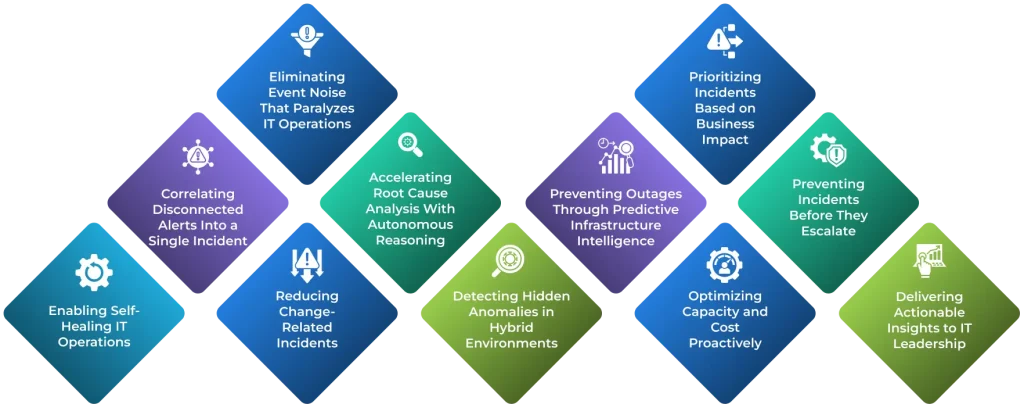
Below are practical, real-world examples of how agentic AI is transforming ITOM for modern enterprises.
1. Eliminating Event Noise That Paralyzes IT Operations
The problem :-
In large IT environments, monitoring tools generate thousands of events per hour. CPU spikes, transient network delays, and application retries often trigger alerts that do not require action. IT teams waste time manually reviewing dashboards while genuinely critical issues are buried in noise.
How agentic AI solves it :-
Agentic AI continuously observes incoming events across tools integrated with ServiceNow ITOM. It learns which event patterns historically led to incidents and which resolved themselves without impact. Based on this learning, the AI autonomously suppresses low-value alerts, groups related signals, and dynamically adjusts thresholds in real time.
Example :-
If a virtual machine shows short-lived CPU spikes every night due to a scheduled batch job, agentic AI learns that this pattern does not require intervention. When a similar spike occurs unexpectedly during peak business hours and correlates with application latency, the AI escalates it immediately.
The result :-
Alert volumes drop significantly, IT teams focus only on meaningful issues, and response times improve without sacrificing visibility.
2. Correlating Disconnected Alerts Into a Single Incident
The problem :-
A single infrastructure failure often triggers multiple alerts across servers, databases, applications, and network devices. Each alert may generate a separate incident, leading to duplication of effort and confusion across teams.
How agentic AI solves it :-
Agentic AI reasons across topology data and service relationships in ServiceNow ITOM. It understands how components depend on each other and autonomously correlates related alerts into one incident, continuously refining the incident context as new data arrives.
Example :-
A failed storage node causes database latency, which then impacts an e-commerce application. Instead of three separate incidents, agentic AI creates one correlated incident that clearly identifies the storage layer as the probable source.
The result :-
IT teams immediately understand what is happening, reduce handoffs, and resolve incidents faster with shared context.
3. Accelerating Root Cause Analysis With Autonomous Reasoning
The problem :-
Root cause analysis often relies on senior engineers manually tracing dependencies, reviewing logs, and recalling past incidents. This process is slow and prone to human error.
How agentic AI solves it :-
Agentic AI evaluates configuration changes, topology data, historical incidents, and live metrics simultaneously. It generates multiple hypotheses for root cause and tests them against incoming data, refining conclusions as conditions change.
Example :-
After a performance degradation, agentic AI identifies that a recent configuration change to a load balancer coincides with increased error rates. As new metrics confirm traffic imbalance, the AI strengthens its confidence in that root cause.
The result :-
Root causes are identified faster and more accurately, reducing repeat incidents and improving service stability.
4. Preventing Outages Through Predictive Infrastructure Intelligence
The problem :-
Traditional monitoring detects failures only after thresholds are breached, leaving little opportunity for prevention.
How agentic AI solves it :-
Agentic AI analyzes long-term behavior patterns such as memory growth, disk I/O trends, and response latency. It detects subtle deviations that indicate impending failure and autonomously initiates preventive actions.
Example :-
Agentic AI detects abnormal memory consumption in an application server that historically leads to crashes within 48 hours. It triggers a controlled restart during a low-traffic window instead of waiting for a production outage.
The result :-
Downtime is avoided, service availability improves, and IT teams move from reactive to preventive operations.
5. Prioritizing Incidents Based on Business Impact
The problem :-
IT teams often treat incidents equally, even though some affect critical revenue-generating services while others have minimal impact.
How agentic AI solves it :-
Agentic AI understands service hierarchies and business criticality within ServiceNow ITOM. It continuously evaluates which applications and users are affected and dynamically reprioritizes incidents accordingly.
Example :-
If a minor infrastructure issue affects a development environment, it is deprioritized. If the same issue affects a customer-facing payment system, the AI immediately escalates it.
The result :-
Business-critical services are restored first, minimizing financial and reputational impact.
6. Preventing Incidents Before They Escalate
The problem :-
Many incidents begin as minor issues that escalate due to a delayed response.
How agentic AI solves it:
Agentic AI detects early warning signs and autonomously executes preventive workflows, such as scaling resources or adjusting configurations, within approved governance limits.
Example :-
When increased response times are detected in a customer portal, agentic AI scales backend resources before users experience slowdowns.
The result :-
Major incidents become less frequent, and overall system reliability improves.
7. Enabling Self-Healing IT Operations
The problem :-
Manual remediation delays resolution, especially during off-hours.
How agentic AI solves it :-
Agentic AI executes remediation actions automatically based on learned success patterns. Over time, it improves its decision-making by learning which actions resolve issues most effectively.
Example :-
If an application service repeatedly recovers after a specific restart sequence, agentic AI autonomously applies that fix whenever the issue recurs.
The result :-
Faster recovery, reduced on-call workload, and consistent uptime.
8. Reducing Change-Related Incidents
The problem :-
Changes often cause outages due to unknown dependencies or poor timing.
How agentic AI solves it :-
Agentic AI analyzes historical change outcomes, current system health, and dependency maps to assess risk before implementation.
Example :-
If similar changes previously caused incidents during peak hours, the AI recommends deploying during a low-risk window.
The result :-
Higher change success rates and fewer post-change incidents.
9. Detecting Hidden Anomalies in Hybrid Environments
The problem :-
Hybrid and cloud environments make it difficult to identify subtle issues early.
How agentic AI solves it :-
Agentic AI learns normal behavior patterns for each environment and flags deviations that indicate emerging problems.
Example :-
The AI detects gradually increasing API latency in a cloud service before users report performance issues.
The result :-
Early intervention reduces downtime and customer impact.
10. Optimizing Capacity and Cost Proactively
The problem :-
Manual capacity planning often leads to overprovisioning or shortages.
How agentic AI solves it :-
Agentic AI forecasts demand using historical usage patterns and recommends scaling actions.
Example :-
The AI identifies underutilized cloud instances and recommends downsizing without affecting performance.
The result :-
Lower infrastructure costs and improved performance stability.
11. Delivering Actionable Insights to IT Leadership
The problem :-
IT leaders lack visibility into systemic operational risks.
How agentic AI solves it :-
Agentic AI aggregates trends across incidents and remediation actions to surface strategic insights.
Example :-
Leadership dashboards highlight recurring failure patterns linked to a specific application architecture.
The result :-
Better long-term decisions and continuous operational improvement
Also Reads :-
1. ServiceNow Agentic Playbooks – The Future of Workflow Automation
Conclusion
Agentic AI represents a fundamental shift in how IT operations are designed, executed, and scaled. Instead of relying on static rules, manual intervention, or reactive automation, agentic AI systems continuously observe operational conditions, reason over complex dependencies, and take autonomous actions within defined guardrails. In the context of ServiceNow ITOM, this capability transforms IT from a reactive support function into a proactive, intelligent, and resilient operational backbone.
The use cases explored in this blog demonstrate how agentic AI addresses real, persistent ITOM challenges—event noise, slow root cause analysis, reactive incident management, and operational scalability. By applying reasoning and learning at scale, ServiceNow ITOM agentic AI enables IT teams to prevent outages before they occur, resolve incidents faster when they do happen, and continuously optimize infrastructure performance and cost.
For modern IT teams operating in hybrid and cloud-native environments, adopting agentic AI is no longer an experimental initiative. It is a practical, strategic approach to maintaining service reliability, improving operational efficiency, and aligning IT outcomes with business priorities. Organizations that invest in agentic AI today will be better positioned to support future growth, complexity, and digital transformation with confidence.
Frequently Asked Questions (FAQs)
1. What makes agentic AI different from traditional automation in ServiceNow ITOM?
Traditional automation in ServiceNow ITOM follows predefined rules and workflows that require manual configuration and updates. Agentic AI, on the other hand, can observe operational data, reason about changing conditions, and decide which actions to take without constant human input. It learns from historical outcomes and adapts its behavior over time, making IT operations more resilient and intelligent.
2. How does agentic AI improve incident management in ServiceNow ITOM?
Agentic AI improves incident management by correlating related alerts, identifying probable root causes, and triggering remediation actions automatically. Instead of waiting for incidents to escalate, the AI detects early warning signals and takes preventive action. This reduces incident volume, shortens resolution times, and improves overall service availability.
3. Can agentic AI operate safely without human intervention?
Yes, agentic AI operates within clearly defined governance boundaries. In ServiceNow ITOM, organizations can specify which actions the AI is allowed to execute autonomously and when human approval is required. This ensures that automation remains controlled, auditable, and aligned with organizational risk policies.
4. Is agentic AI suitable for hybrid and multi-cloud environments?
Agentic AI is particularly effective in hybrid and multi-cloud environments because it can reason across diverse data sources, infrastructure types, and operational tools. By learning normal behavior patterns for each environment, the AI adapts its decision-making logic as systems evolve, ensuring consistent operational intelligence across complex architectures.
5. How long does it take to see value from ServiceNow ITOM agentic AI?
Many organizations begin seeing value within weeks of deployment, especially in areas such as alert noise reduction and incident correlation. More advanced benefits, such as predictive intelligence and self-healing operations, improve over time as the AI continues to learn from operational data and historical outcomes.