
Table of Contents
- 1. Introduction – Why ServiceNow Telecom Transformation Is Critical Today
- 2. Challenges That Make Telecom Transformation Essential
- 3. Why Traditional Tools Fail and How ServiceNow Telecom Solutions Solve It
- 4. ServiceNow Telecom Transformation – Key Solutions for End-to-End Operations
- 5. Persona-Based Benefits of ServiceNow Telecom Transformation
- 6. Supporting Different Telco Models
- 7. The Outcome: End-to-End Telecom Transformation
- 8. Conclusion – Transforming Telecom with ServiceNow and LMTEQ
- 9. Frequently Asked Questions
The telecommunications industry is evolving faster than ever. Legacy systems, fragmented customer experiences, and disconnected operational processes are holding many Communication Service Providers (CSPs) back at a time when agility, reliability, and digital-first experiences are critical. ServiceNow telecom transformation provides an end-to-end, AI-powered platform that unifies service, network, and operational workflows, enabling telcos to improve customer satisfaction, reduce costs, and innovate faster.
By integrating solutions like TSM, SOMT, TSOM, TNI, FSMT, and SPMT on a single platform, ServiceNow enables telecom providers to move beyond siloed systems and achieve comprehensive digital transformation.
Introduction – Why ServiceNow Telecom Transformation Is Critical Today
Telecom providers today face multiple pressures: rapidly increasing customer expectations, rising network complexity, workforce shortages, and the need to modernize legacy systems. Fragmented IT and operational systems make it difficult to monitor network health, resolve customer issues, or deploy new services efficiently. These challenges result in slower response times, higher operational costs, and inconsistent customer experiences.
A unified platform like ServiceNow telecom transformation helps telcos connect CX, network operations, field service, and strategic planning under one AI-driven system, turning complexity into a competitive advantage.
Challenges That Make Telecom Transformation Essential
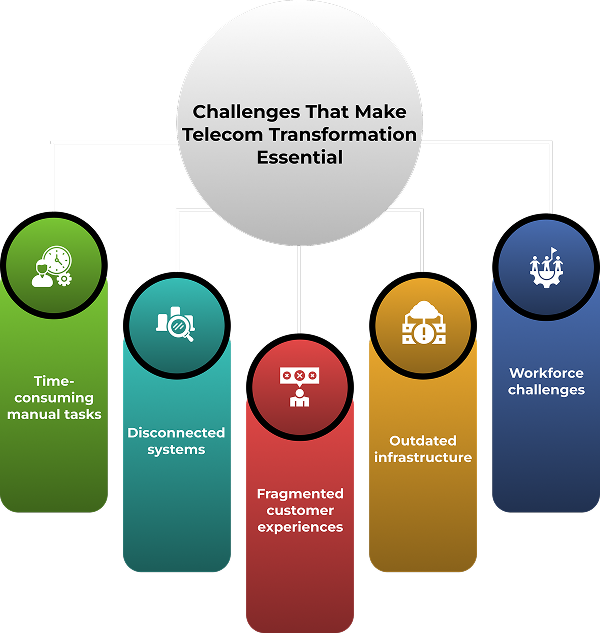
Telecom providers, whether traditional or next-generation, face recurring operational hurdles:
Time-consuming manual tasks – Technicians spend hours on activities like logging work orders, requesting parts, updating inventory, and reporting, reducing their ability to focus on high-value service tasks.
Disconnected systems – Multiple legacy platforms create visibility gaps across network, service, and customer operations, making it challenging to monitor performance or respond proactively to outages.
Fragmented customer experiences – Without integrated systems, interactions are inconsistent, case resolutions are slow, and personalized service is limited, reducing customer satisfaction and loyalty.
Outdated infrastructure – Legacy tools prevent end-to-end visibility, slow deployment of new services, and increase operational costs.
Workforce challenges – Talent shortages and a retiring workforce create difficulties in onboarding, retaining, and scaling skilled technicians.
These operational gaps underscore the need for a single, intelligent platform that can unify network operations, service management, and customer engagement.
Why Traditional Tools Fail and How ServiceNow Telecom Solutions Solve It
Traditional telecom systems operate in silos. Customer service platforms, network monitoring tools, and field service applications rarely communicate, leaving gaps that delay issue resolution and frustrate customers. CSPs often rely on manual intervention to reconcile disparate data, causing inefficiencies and errors.
ServiceNow telecom solutions overcome these challenges by providing a single source of truth for service and network operations. AI-driven automation, workflow orchestration, and real-time analytics allow CSPs to proactively identify and resolve issues before they impact customers.
ServiceNow Telecom Transformation – Key Solutions for End-to-End Operations
Telecommunications Service Management (TSM) – Unifying Network and Service Operations
TSM consolidates network and service workflows into a single AI-powered platform, addressing legacy system inefficiencies. By providing real-time visibility into network health, service delivery, and customer interactions, TSM enables proactive problem resolution and consistent customer experiences. Out-of-the-box standards, pre-built integrations, and AI-driven alerts reduce manual effort and accelerate adoption.
Sales and Order Management for Telecommunications (SOMT) – Accelerating Revenue and Fulfillment
SOMT integrates sales, order processing, and post-sales service on a single AI platform. CSPs can launch new offerings rapidly, streamline complex order workflows, and deliver personalized customer experiences. By consolidating sales, fulfillment, and service management, SOMT improves operational efficiency while supporting revenue growth.
Telecommunications Service Operations Management (TSOM) – Enhancing Network Reliability
TSOM provides unified visibility into service performance and network activity. AI-driven monitoring and pre-built workflows enable proactive detection and resolution of network issues. This ensures consistent service reliability, faster incident response, and lower operational costs, making CSPs more competitive in a fast-paced market.
Telecommunications Network Inventory (TNI) – Optimizing Resources and Change Management
TNI automates inventory management across the network lifecycle—from planning to deployment and change tracking. By consolidating asset data, CSPs gain full visibility into resources, reduce errors, and accelerate the rollout of critical network initiatives. Accurate inventory data also enables proactive capacity planning and network optimization.
Field Service Management for Telecommunications (FSMT): Boosting Technician Efficiency
FSMT improves technician productivity through intelligent scheduling, automated task management, and streamlined service processes. Routine tasks are automated, allowing field teams to focus on high-value interventions. This reduces operational costs, improves first-time fix rates, and delivers consistent, proactive support to customers.
Strategic Portfolio Management for Telecommunications (SPMT): Aligning Business and Technology Goals
SPMT helps telecom executives prioritize investments, build strategic roadmaps, and align projects with business objectives. Integrated strategy, planning, and delivery ensure faster project execution and optimized allocation of resources, providing measurable business outcomes.
Persona-Based Benefits of ServiceNow Telecom Transformation
Customer Service Agents (CSAs) :- Real-time visibility into customer and network data allows CSAs to resolve issues faster and deliver proactive, personalized support using AI-generated summaries.
Network Engineers :- AI-driven monitoring and diagnostics enable rapid identification of network issues and their impact on services, reducing downtime and improving Mean Time to Repair (MTTR).
Partners and Suppliers :- Streamlined order processing, fulfillment tracking, and inventory visibility enhance collaboration and operational efficiency.
COOs :- Optimize internal processes, reduce costs, and scale operations without increasing headcount.
CPOs / CDOs :- Launch digital-first products faster, deliver superior CX, and increase customer lifetime value.
CTOs / CIOs :- Achieve end-to-end visibility across service and network operations, prevent outages proactively, and modernize infrastructure while reducing TCO.
Supporting Different Telco Models
Legacy Telcos :- ServiceNow enables modernization, integrates siloed systems, and creates agile operations that overcome legacy infrastructure limitations.
Startups / Next-Gen Telcos :- Cloud-native and AI-driven, these telcos can scale rapidly, deploy new services quickly, and leverage automation for operational efficiency.
Industry Adjacent Players :- Equipment vendors and managed service providers can extend their offerings with ServiceNow solutions, including private 5G, edge computing, and enterprise network management.
The Outcome: End-to-End Telecom Transformation
By implementing ServiceNow telecom transformation, CSPs achieve :-
- Operational Efficiency :- Reduced manual effort, faster resolution, improved uptime
- Customer Experience :- Proactive, personalized service across channels
- Revenue Growth :- Faster product launches, optimized fulfillment, AI-driven post-sales management
- Strategic Alignment :- Investment prioritization, roadmap execution, and resource optimization
ServiceNow provides a single system of action that connects CX, network operations, field service, inventory, and portfolio management, empowering telecom providers to innovate and compete in the digital era.
Also Reads :-
Conclusion – Transforming Telecom with ServiceNow and LMTEQ
ServiceNow telecom transformation solutions enable CSPs to unify service, network, and operations on a single AI-powered platform. By integrating TSM, SOMT, TSOM, TNI, FSMT, and SPMT, telecom providers can overcome legacy challenges, optimize operations, and deliver exceptional customer experiences.
LMTEQ, as a trusted implementation partner, ensures seamless deployment, workflow automation, and measurable business outcomes. With LMTEQ, CSPs can accelerate adoption, reduce operational costs, improve CX, and achieve faster ROI from their ServiceNow investment.
Together, ServiceNow and LMTEQ empower telecom providers to turn complex challenges into competitive advantages and position themselves for sustainable growth in the digital telecom era.
Frequently Asked Questions (FAQs)
1. Can ServiceNow handle both legacy and modern telecom networks?
Yes, ServiceNow’s AI-powered platform supports legacy systems and next-gen telecom environments, enabling seamless integration, automation, and proactive monitoring across all network types.
2. How does ServiceNow improve field technician productivity?
By automating routine tasks, optimizing scheduling, and providing real-time visibility, ServiceNow allows field teams to focus on high-value work, reducing downtime and operational costs.
3. Is implementing ServiceNow complex for telecom providers?
With a trusted implementation partner like LMTEQ, deployment is streamlined. They ensure smooth configuration, workflow automation, and adoption, helping CSPs achieve faster ROI with minimal disruption.