
Transforming Application Management with ServiceNow Custom Development for a Leading Bank
Introduction

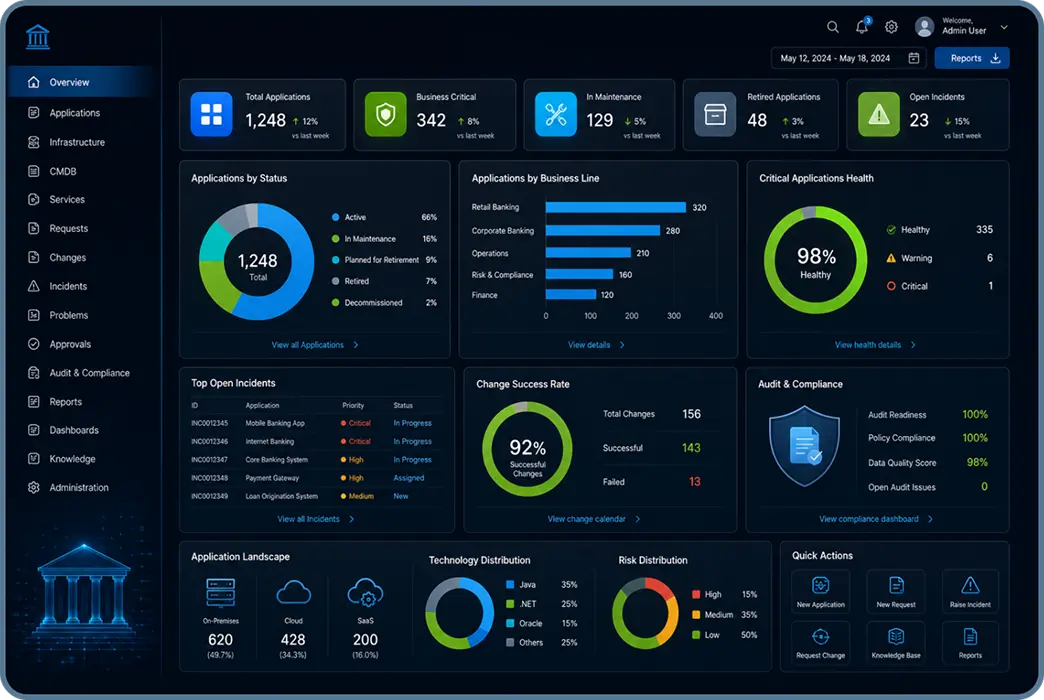
In the high-velocity landscape of India’s digital banking revolution, operational agility is the ultimate differentiator. A Leading Private Sector Bank partnered with LMTEQ to modernize a fragmented legacy environment and architect for a unified digital future. By engineering a custom-built solution on ServiceNow App Engine, LMTEQ transitioned the institution from siloed, manual processes to a high-performance Centralized Digital Command Center. The result was a 80% reduction in manual activities and a 100% audit-ready posture, solidifying the bank’s position at the forefront of technological excellence in the Banking, Financial Services, and Insurance (BFSI) sector
Client Overview
The client is a leading institution in the Banking and Financial Services & Insurance (BFSI) sector, operating across diverse business lines including retail and corporate banking. With a large and complex application landscape supporting mission-critical operations, the institution required a robust, scalable, and structured approach to effectively manage application lifecycles, interdependencies, and compliance mandates.
As a systemically significant financial entity, the institution operates in a high-stakes environment where operational resilience, transparency, and regulatory alignment are non-negotiable. Ensuring data accuracy, ownership accountability, and complete audit traceability became critical priorities, necessitating a centralized and governance-driven transformation.
Key Challenges
- Fragmented Systems & Unstructured Data: – The client relied on multiple legacy tools operating in silos. This resulted in duplicate records and an inability to establish meaningful relationships between applications and underlying components.
- Absence of Centralized Lifecycle Management: – Without a unified framework for onboarding, maintenance, and decommissioning, ownership accountability was unclear, leading to gaps in governance and lifecycle control.
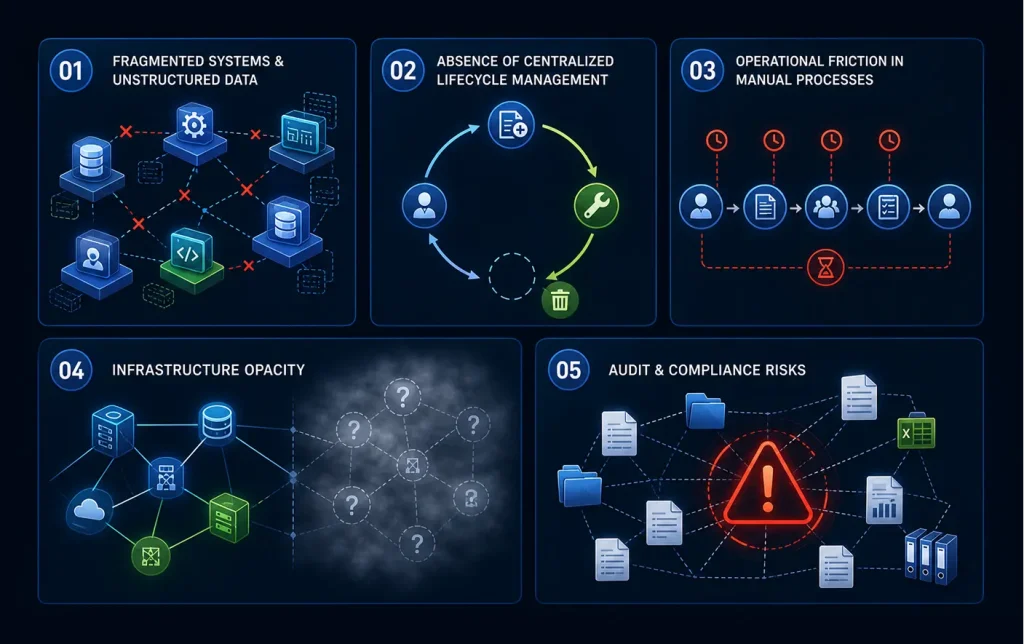
- Operational Friction in Manual Processes: – Application management involved heavy manual coordination across IT, operations, and compliance. The lack of automated approval mechanisms increased the risk of human error and delayed turnaround times.
- Infrastructure Opacity: – A lack of visibility into application dependencies restricted accurate impact analysis during incidents, leading to increased downtime and challenges in risk assessment.
- Audit & Compliance Risks: – In a highly regulated BFSI environment, the absence of a centralized “Single Source of Truth” made audit processes time-consuming and complex.
Solution Delivered
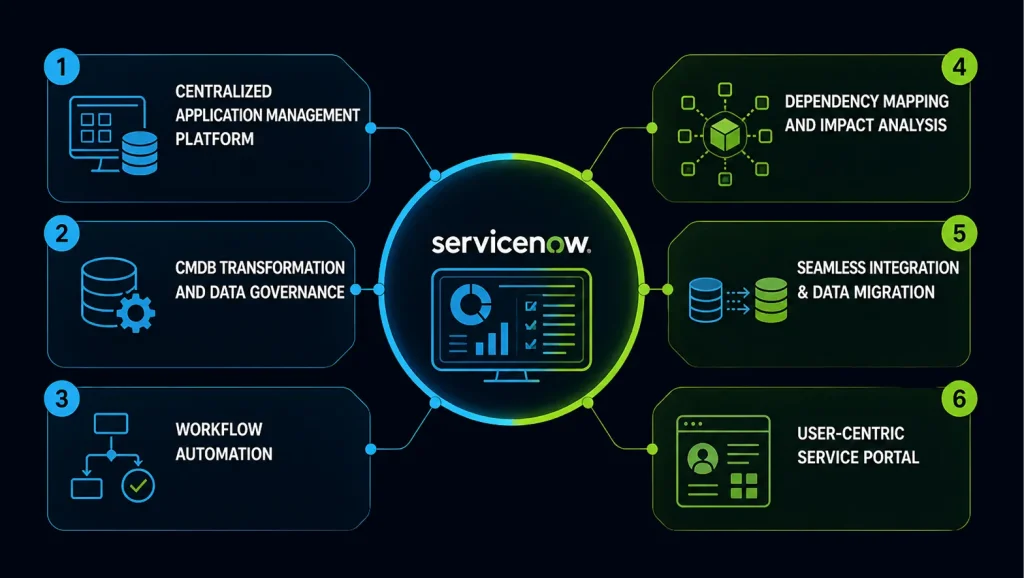
- Centralized Application Management Platform: – Established a single source of truth for all application data through a unified interface. This eliminated reliance on disparate tools and significantly improved data accessibility and control.
- CMDB Transformation and Data Governance: – Rationalized the data landscape through cleansing and standardization. Defined clear relationships between applications and infrastructure components, enabling high-fidelity dependency mapping and stronger data integrity.
- Workflow Automation: – Automated end-to-end workflows to streamline multi-stakeholder approvals. This digitization reduced manual intervention, accelerated processing times, and mitigated operational risk.
- Dependency Mapping and Impact Analysis: – Implemented real-time impact analysis capabilities. Teams can now proactively assess risks during incidents and changes, drastically reducing service disruptions.
- Seamless Integration & Data Migration: – Utilized ServiceNow data sources and transform maps to migrate critical historical data from legacy systems. This ensured a zero-disruption transition while preserving vital compliance insights.
- User-Centric Service Portal: – Designed an intuitive, role-based portal to accelerate adoption. Simplified navigation and task execution improved productivity across both business and IT teams.
Business Outcomes
| Metric | Achievement | Strategic Impact |
|---|---|---|
| Operational Efficiency | 70% Improvement | Standardized practices and eliminated process bottlenecks across all cross-functional teams. |
| Manual Effort | 80% Reduced | Eradicated manual coordination, allowing talent to pivot from maintenance to strategic innovation. |
| Audit & Compliance | 100% Readiness | Established immutable traceability, simplifying regulatory audits in a high-stakes environment. |
| Decision Visibility | High-Fidelity Dashboards | Real-time transparency enables faster, data-driven decision-making and seamless collaboration. |
| Risk Resilience | Proactive Mitigation | Advanced impact analysis capabilities resulted in significantly reduced system downtime. |
Conclusion
LMTEQ has redefined the institution’s operational core, pivoting from legacy friction to a unified, intelligence-driven command center. This transformation is more than a technical upgrade; it is a Strategic Moat. By harmonizing custom development with robust data governance, we have engineered a Scalable Intelligence Framework that empowers the bank to outpace market complexity. With 100% traceability and a 80% reduction in manual drag, the institution is no longer just managing its digital estate it is uniquely positioned to dominate the future of India’s BFSI economy with absolute confidence and audit-ready precision.
Connect with LMTEQ to discover how ServiceNow Custom Development solutions can streamline application management, improve governance, enhance operational visibility, and accelerate digital transformation across your enterprise.