
Table of Contents
- 1. Introduction
- 2. What Is a ServiceNow CMDB?
- 3. What Is ServiceNow CSDM?
- 4. The ServiceNow CSDM Domain Structure Explained
- 5. The ServiceNow CSDM Maturity Model: Crawl, Walk, Run, Fly
- 6. Why ServiceNow CSDM Alignment Matters for a Reliable CMDB
- 7. Practical Steps to Start ServiceNow CSDM Alignment
- 8. LMTEQ: Your ServiceNow CSDM Alignment Partner
- 9. Frequently Asked Questions
- 10. Conclusion
1. Introduction
Most enterprises running ServiceNow already have a Configuration Management Database in place. Servers are logged, applications are tracked, and relationships between assets exist somewhere in the system. Yet when leadership asks a simple question, such as which business services depend on a particular server, many teams struggle to answer with confidence. The problem is rarely a lack of data. It is a lack of structure, and this is where the Common Service Data Model, or CSDM, comes in.
CSDM is ServiceNow’s official framework for organizing CMDB data, so it reflects how the business operates, not just what infrastructure exists. This guide breaks down what CSDM is, how it functions inside the CMDB, and the maturity stages organizations move through to build a CMDB that is genuinely reliable.
2. What Is a ServiceNow CMDB?
A Configuration Management Database, or CMDB, is the repository within ServiceNow that stores Configuration Items, commonly called CIs. These include servers, applications, network devices, and the business services they support, along with the relationships connecting with them. Think of the CMDB as the raw data layer, telling you what exists in your environment.
CIs are organized into classes, such as hardware, software, network, and cloud resources, each with its own attributes. A CMDB is widely recognized as the foundation of the ServiceNow platform, and when implemented correctly, it becomes a service aware data model that supports automation and operational visibility, rather than a plain technical inventory. More detail is available in ServiceNow’s own CMDB knowledge resource.
3. What Is ServiceNow CSDM?
CSDM is a framework that provides guidance on how data regarding applications and services should be organized within the CMDB. It establishes standard, shared definitions used across every ServiceNow product so that service level reporting works. Where the CMDB tells you what data exists, CSDM tells you how that data should be structured, classified, and connected, so it becomes usable.
CSDM is not a separate application or a switch you turn on. It is prescriptive guidance that organizations adapt to their own service landscape, and it depends heavily on governance since even strong discovery tools cannot produce a trustworthy service model without service data being consistently defined and maintained. ServiceNow’s community writes up on CMDB and CSDM governance covers this in more depth.
4. The ServiceNow CSDM Domain Structure Explained
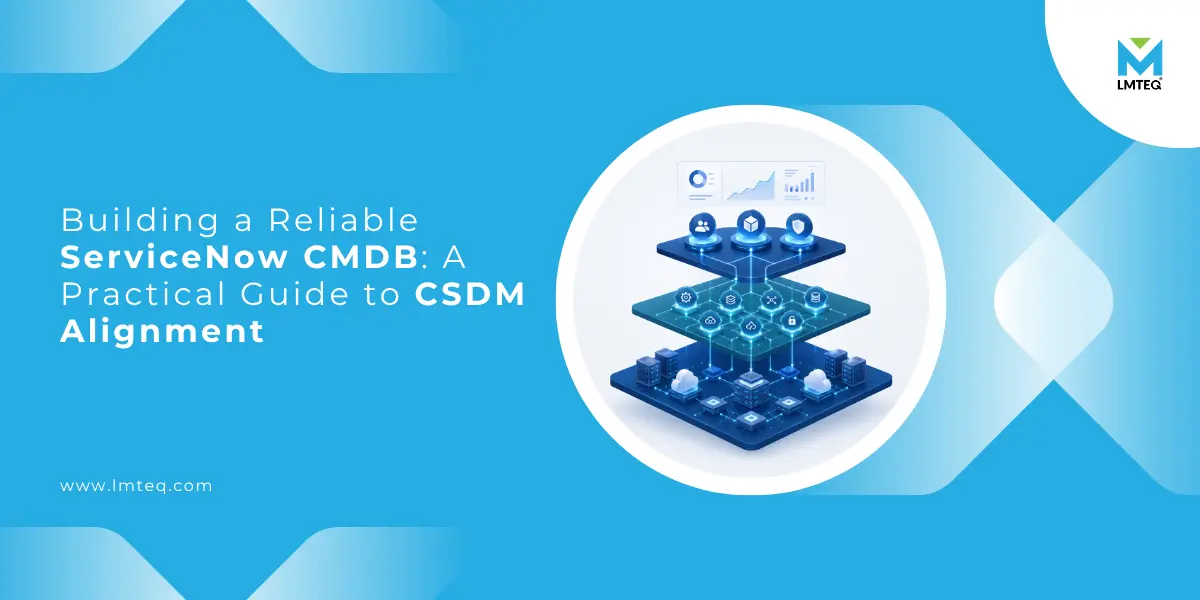
CSDM organizes CMDB data into layered domains, moving from technical infrastructure at the bottom to business context at the top:
Foundation covers physical and logical infrastructure data, including servers, cloud resources, and network components.
Design captures how services and applications are architected before deployment.
Manage Technical Services covers technical building blocks such as databases, middleware, and APIs.
Manage Business Services covers the services that end users and customers actually consume.
Consume covers service offerings, catalog items, and entitlements available to end users.
Each layer connects to the one below it. This means a failure at the infrastructure level can be traced upward to show exactly which business service it affects, rather than leaving teams to guess downstream impact.
5. The ServiceNow CSDM Maturity Model: Crawl, Walk, Run, Fly
ServiceNow does not expect organizations to implement CSDM in one attempt. It recommends a staged approach, often described as Crawl, Walk, Run, and Fly, with a Foundation stage underpinning all four. Each stage represents a deeper level of alignment between the CMDB, service architecture, and operational processes, and organizations that treat this as a maturity journey rather than a single rollout tend to build service models that hold up as the environment scales.
Foundation establishes core reference data such as companies, locations, users, and groups. Every later stage depends on this being accurate.
Crawl introduces Business Applications and Application Services, along with the minimum relationships needed to support Incident, Problem, and Change processes.
Walk adds Technical Services and Technical Service Offerings, capturing the metadata needed to support and manage CIs properly.
Run introduces Business Services and Service Offerings, the layer where technical infrastructure is translated into language the business understands.
Fly adds Business Capabilities and information objects, connecting the Service Catalog directly to Service Offerings. At this stage, the CMDB shifts from an operational tool into a strategic input for portfolio planning and enterprise decision making. This stage introduces dedicated tables for Business Capability, representing the core functions the business must perform to reach its objectives, which gives enterprise architecture and investment planning a direct link back to the CMDB.
Full stage by stage detail is available in ServiceNow’s own documentation on the Crawl stage and Walk stage of CSDM implementation.
6. Why ServiceNow CSDM Alignment Matters for a Reliable CMDB
A CMDB without CSDM alignment can still collect data, but that data tends to become inconsistent as more teams populate it in different ways. This creates real operational problems: inaccurate impact analysis, unreliable reporting, and automation that fails because it cannot trust the underlying relationships.
As organizations progress through the maturity stages, operational metrics such as mean time to resolution, alert correlation effectiveness, and change success rates tend to improve, giving teams a measurable way to demonstrate that alignment work is paying off rather than just adding process overhead.
CSDM alignment does not require a complete redesign of an existing CMDB. Most organizations start by mapping existing CI classes to CSDM equivalents and standardizing naming conventions, then expand in stages rather than attempting everything at once.
7. Practical Steps to Start ServiceNow CSDM Alignment
- Audit your foundation data first. Confirm companies, locations, users, and groups are accurate before building anything on top of them.
- Start with one service or department. Attempting an organization wide rollout on day one is a common reason CSDM initiatives stall.
- Map existing CI classes to CSDM equivalents. This avoids duplicating work already done in your current CMDB.
- Use automated discovery where possible. Manual data capture becomes unsustainable as your CSDM footprint grows through the Walk and Run stages.
- Assign clear data ownership. Since CSDM depends on governance, decide upfront who owns foundation data, who owns service definitions, and who signs off on new CI classes.
8. LMTEQ: Your ServiceNow CSDM Alignment Partner
As a ServiceNow Elite Partner, LMTEQ works closely with enterprises to evaluate their existing CMDB and pinpoint exactly where gaps in CSDM alignment are affecting reporting, automation, and impact analysis. Our team handles foundation data audits, CI class mapping, and governance planning so that alignment work builds on a solid base rather than adding more inconsistency.
From early-stage Crawl implementations to advancing toward Run and Fly for full business service visibility, LMTEQ guides organizations through each maturity stage with a practical, phased approach that shows measurable progress along the way.
9. Frequently Asked Questions
Is CSDM a ServiceNow product I need to purchase separately?
Do we need to rebuild our CMDB from scratch to align with CSDM?
How long does it take to reach full CSDM maturity?
10. Conclusion
A reliable CMDB is not simply a matter of populating more records. It requires structure, and CSDM is the framework ServiceNow provides to deliver that structure consistently across every product on the platform. Approached as a staged maturity journey, from Foundation through Crawl, Walk, Run, and Fly, CSDM alignment turns a CMDB from a static inventory into a service aware system that supports real operational and business decisions.
As a ServiceNow Elite Partner, LMTEQ works with enterprises to assess CMDB health, plan CSDM alignment roadmaps, and implement them in stages that deliver value early rather than waiting until a full rollout is complete.