
Modernizing Supply Chain Helpdesk Operations with ServiceNow CSM
Introduction

Client Overview
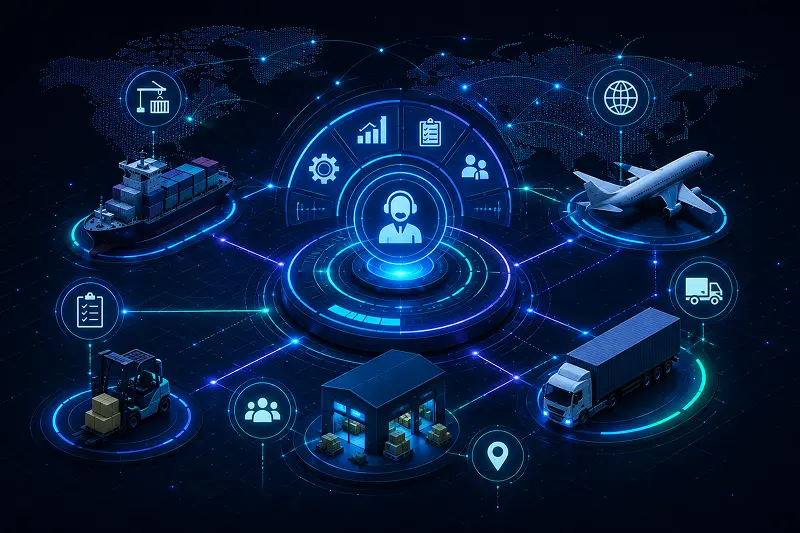
The client is an India-based global supply chain and logistics enterprise operating across 25+ countries, serving customers in the automotive, industrial, consumer, technology, infrastructure, and healthcare sectors. With expertise spanning sourcing and procurement, integrated transportation, in-plant logistics, finished goods fulfillment, global forwarding, and last-mile solutions, the enterprise is trusted by over 91 Fortune 500 companies.
The enterprise runs 11 specialized teams, each governing a distinct operational process, with over 200 mailboxes actively used for ticket creation and communication – up to 30 per team. Supporting this complexity required centralized visibility, intelligent automation, and structured governance that their existing legacy system could no longer provide.
Key Challenges
Before migrating to ServiceNow CSM, the enterprise faced a range of operational and technical challenges rooted in the limitations of their existing legacy helpdesk platform:
- No Unified Customer Portal: – The legacy tool lacked a self-service customer portal, forcing all client and vendor interactions to flow entirely through email and manual coordination. Customers had no centralized interface to raise requests, track case status, or access service history creating friction, lack of transparency, and an over-reliance on email communication across all teams.
- Inefficient Email Handling: – The existing system lacked the ability to auto-close unwanted or redundant emails and offered no global email search capability. Teams were forced to manually sift through inboxes, leading to missed tickets, delayed responses, and significant time loss across all 11 teams.
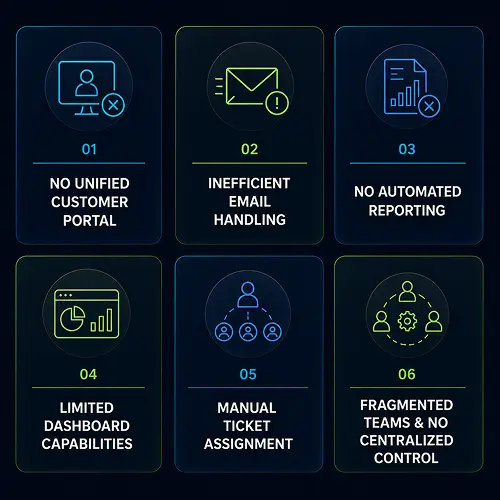
- No Automated Reporting: – Daily reports were generated and distributed entirely by hand. With no scheduling mechanism in place, report delivery depended on individual team members – creating inconsistency, delays, and an increased risk of oversight.
- Limited Dashboard Capabilities: – The legacy platform offered only a basic, inflexible dashboard with minimal customization. Teams had no way to create meaningful views tailored to their specific processes, limiting operational visibility and data-driven decision-making.
- Manual Ticket Assignment: – There was no work assignment engine. Every ticket had to be manually routed to the right team member, creating bottlenecks, uneven workloads, and delays particularly during high-volume periods.
- Fragmented Teams with No Centralized Control: – Each of the 11 teams functioned in isolation. Without a unified dashboard or shared visibility layer, it was impossible to get an enterprise-wide view of service performance, ticket status, or team workloads.
Solution Delivered
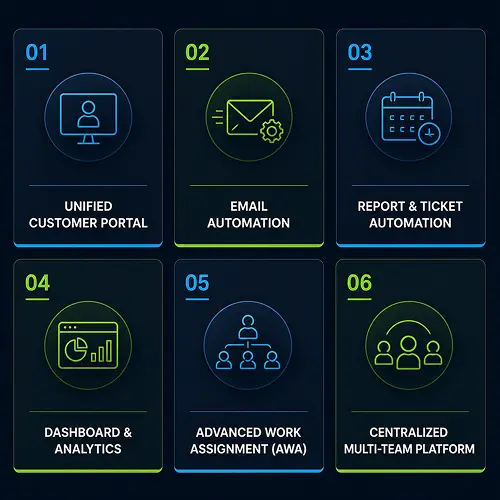
- Unified Customer Portal: – A dedicated ServiceNow Customer Portal was deployed, giving clients and vendors a single, self-service interface to submit requests, track case progress in real time, view historical interactions, and communicate directly with the relevant team. This eliminated the dependency on fragmented email-only workflows and delivered a transparent, professional service experience for all external stakeholders.
- Intelligent Email Automation: – Automated workflows were configured to handle the entire email lifecycle from intake to closure. Auto-close rules eliminate noise from spam and irrelevant communications, while a global email search capability allows any team member to retrieve records instantly. Now Assist AI was integrated to generate automatic case summaries from email content, and resolution codes are now auto generated based on case outcomes removing a repetitive manual step from every ticket closure.
- Scheduled Report and Ticket Generation: – Automated report scheduling was implemented to replace the manual daily reporting process. Teams configure delivery on a defined schedule, ensuring timely, consistent insights with zero human intervention. Scheduled ticket generation was also enabled for recurring service needs, further reducing operational overhead.
- Advanced Dashboard and Analytics: – ServiceNow’s fully configurable dashboard environment was deployed, giving each of the 11 teams the ability to build and manage unlimited, role-specific dashboards. From real-time ticket status views to trend analytics and SLA performance tracking, every team now has complete visibility tailored to their operational context.
- Advanced Work Assignment (AWA): – ServiceNow’s AWA engine was integrated to fully eliminate manual ticket routing. Tickets are now automatically assigned to the most appropriate available agent based on real-time availability, skill mapping, and team capacity ensuring faster resolution and balanced workload distribution across all teams.
- Centralized Multi-Team Platform with 200 Mailboxes: – All 11 teams spanning quality, logistics, procurement, vendor management, and more were unified under a single ServiceNow CSM instance. Over 200 mailboxes were successfully onboarded and mapped to their respective teams (up to 30 mailboxes per team), giving the enterprise a fully centralized, yet team-specific, service management structure for the first time.
Results & Business Impact
| Metric | Achievement | Strategic Impact |
|---|---|---|
| Customer Portal Adoption | 100% Centralized | All client & vendor interactions moved to ServiceNow CSM portal |
| Manual Effort | ↓ 65% Reduction | Teams freed from repetitive coordination tasks |
| Ticket Assignment Speed | ↑ 80% Faster | AWA routes tickets instantly based on availability and skills |
| Email Processing Efficiency | ↑ 75% Improvement | Auto-closure, AI summarization & global search enabled |
| Report Generation Time | ↓ 90% Reduction | Scheduled reports replace daily manual effort |
| Dashboard Visibility | 100% Centralized | All 11 teams unified on a single real-time platform |
Conclusion
Transform Your Supply Chain Service Operations with ServiceNow CSM
Unify your teams, automate customer workflows, and deliver seamless vendor and client experiences with LMTEQ’s ServiceNow CSM solutions.