
Table of Contents
- 1. Introduction
- 2. Why Manufacturers Are Struggling to Achieve Industry 4.0
- 3. The Hidden Cost of Legacy Systems in Manufacturing
- 4. Key Challenges Facing Manufacturing Leaders Today
- 5. How ServiceNow Enables Manufacturing Transformation
- 6. Why Manufacturers Choose LMTEQ for ServiceNow Success
- 7. Conclusion
1. Introduction
Manufacturers are investing heavily in Industry 4.0, AI, automation, and smart factory initiatives to improve efficiency and remain competitive. However, many organizations still rely on disconnected legacy systems that create data silos, manual processes, and operational inefficiencies. To achieve successful manufacturing digital transformation, businesses need a modern platform that connects workflows, people, and technology across the enterprise. ServiceNow helps manufacturers eliminate operational bottlenecks, improve visibility, and accelerate their digital transformation journey.
2. Why Manufacturers Are Struggling to Achieve Industry 4.0
Industry 4.0 promises smart factories, connected operations, predictive maintenance, and real-time visibility across the manufacturing value chain. While many organizations recognize these opportunities, turning vision into reality remains a challenge.
According to the World Economic Forum’s Global Lighthouse Network, leading manufacturers, are leveraging AI, automation, and IoT to improve efficiency, while many organizations still struggle with disconnected systems and fragmented workflows.
One of the primary barriers is the existence of fragmented technology ecosystems. Production systems, maintenance tools, ERP platforms, HR applications, and IT systems often operate independently, creating information silos across departments.
As a result, manufacturing leaders face challenges such as:
- Limited visibility into operations
- Slow response times to production issues
- Inefficient collaboration between teams
- Inconsistent data across systems
- Difficulty scaling digital initiatives
Without a connected digital foundation, even the most ambitious Industry 4.0 initiatives struggle to deliver meaningful results.
3. The Hidden Cost of Legacy Systems in Manufacturing
Many legacy systems continue to perform their original functions, which can make modernization seem less urgent. However, the true cost of these systems often extends far beyond maintenance expenses. Legacy environments frequently contribute to:
Operational Downtime
When systems lack integration, identifying and resolving issues becomes slower. Delays in communication and manual processes can significantly impact production schedules.
Reduced Productivity
Employees often spend valuable time switching between multiple applications, manually updating records, and tracking approvals through emails and spreadsheets.
Limited Business Agility
Manufacturers need to adapt quickly to market changes, customer demands, and supply chain disruptions. Legacy systems often make these adjustments difficult and time-consuming.
Increased Security Risks
Older technologies may not support modern security standards, increasing exposure to cyber threats and compliance risks.
Higher Operating Costs
Maintaining multiple disconnected systems can increase licensing, support, and operational costs while limiting innovation.
These challenges create barriers that prevent organizations from fully realizing the benefits of manufacturing digital transformation.
4. Key Challenges Facing Manufacturing Leaders Today
Manufacturing executives are managing an increasingly complex business environment. Several critical challenges continue to impact operational performance and growth.
IT and Operational Technology Disconnect
Many organizations still struggle to align IT systems with operational technology (OT) environments. This disconnects limits visibility and slows decision-making.
Compliance and Regulatory Requirements
Manufacturers must maintain strict compliance standards while managing audits, documentation, approvals, and reporting requirements.
Cybersecurity Concerns
As manufacturing environments become more connected, organizations must protect critical systems, sensitive data, and production operations from evolving cyber threats.
Workforce Productivity
Employees expect modern digital experiences that simplify their work. Outdated systems often create frustration and reduce productivity.
Scaling AI and Automation Initiatives
Many manufacturers invest in AI and automation projects but struggle to scale them due to fragmented processes and inconsistent data.
To overcome these challenges, organizations require a platform capable of connecting workflows across departments and systems.
5. How ServiceNow Enables Manufacturing Transformation
ServiceNow provides a unified digital platform that helps manufacturers streamline operations, automate workflows, and improve visibility across the enterprise. Rather than introducing another disconnected tool, ServiceNow acts as a central platform that connects people, systems, and processes.
Key capabilities include:
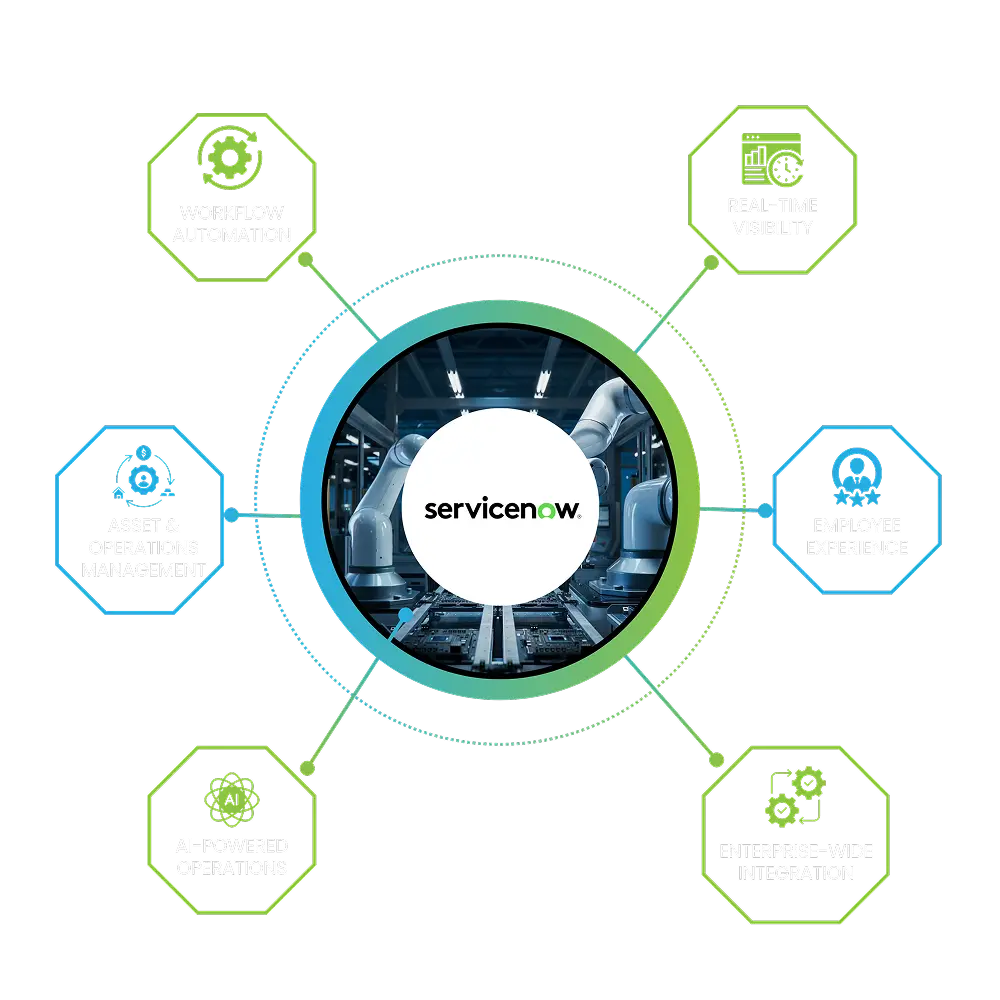
Workflow Automation
Automate repetitive tasks, approvals, service requests, and operational processes to improve efficiency and reduce manual effort.
Real-Time Visibility
Provide stakeholders with a centralized view of operations, incidents, assets, and services across the organization.
Asset and Operations Management
Improve asset performance, reduce downtime, and enhance operational reliability through proactive management and monitoring.
Employee Experience
Deliver modern self-service experiences that help employees access information, submit requests, and resolve issues more efficiently.
AI-Powered Operations
Leverage AI capabilities to improve decision-making, automate routine activities, and accelerate issue resolution.
Enterprise-Wide Integration
Connect existing business applications and systems to create a unified operational environment.
By enabling connected workflows across the organization, ServiceNow helps manufacturers accelerate digital transformation while maximizing the value of existing technology investments.
6. Why Manufacturers Choose LMTEQ for ServiceNow Success
Successful digital transformation requires more than technology—it requires the right implementation partner. As a ServiceNow Elite Partner, LMTEQ helps manufacturers streamline operations, automate workflows, and maximize the value of their ServiceNow investment. With deep platform expertise, a proven delivery approach, and end-to-end implementation services, LMTEQ enables organizations to accelerate their manufacturing digital transformation journey. As a Platinum Sponsor at Manufacturing IT Summit 2026, LMTEQ is also engaging with industry leaders to share practical strategies for modernizing manufacturing operations with ServiceNow.
7. Conclusion
Manufacturing digital transformation is no longer optional for organizations looking to remain competitive in an increasingly connected world. Legacy systems continue to create operational inefficiencies, limit visibility, and slow innovation. By providing a unified platform for workflow automation, asset management, and enterprise-wide collaboration, ServiceNow helps manufacturers modernize operations and accelerate Industry 4.0 initiatives. With the right strategy and implementation partner, manufacturers can build a scalable foundation for long-term growth and operational excellence.